
Military units and combat
Infantry is cheap and spammable, tanks beat infantry at 20 times the price, artillery deletes infantry but dies to anything it cannot keep away, and only planes, artillery and missiles can damage a battleship. Attacking a city from two directions at once captures it far faster.
Control Europe has eight unit types, and only three spawn the moment the match starts — the rest sit behind technology research, which is why the first ten minutes are about money and cities rather than tanks. Where a figure is not published, this page says so instead of guessing.
The eight unit types
| Unit | Spawn cost | Daily upkeep | Manpower | Spawn time | Counters / countered by |
|---|---|---|---|---|---|
| Infantry | 500,000 per 5,000 men | 50,000 | 5,000 per 5,000 men | 15 seconds | Cheap line infantry; beaten by tanks and deleted by artillery |
| Tanks | 10,000,000 per 100 tanks | 300,000 | 10,000 per 100 tanks | 60 seconds | Beats infantry; costs 20x infantry, 6x upkeep, 2x manpower |
| Battleships | 3,500,000,000 for the smallest division | 3,450,000 | 225,000 | Not published | Only planes, artillery and missiles can damage it |
| Planes | Not published | Not published | Not published | Not published | Outperforms artillery; damages battleships; needs an airport |
| Anti Aircraft | Not published | Not published | Not published | Not published | Research-gated; no published cost figures |
| Missile Launcher | Same as tanks | 300,000 | 500 per missile | Not published | Bombs cities; can hit your own troops by mistake |
| Artillery | 100,000 per gun | 15,000 | 5,000 per gun | Not published | Shreds infantry, but not built for a frontal fight |
| Aircraft Carriers | 525,000,000 | 4,500,000 | 200,000 | 120 seconds | Longest range and a mobile airport; countered by battleships |
Infantry, tanks and battleships spawn immediately. The other five require technology first, and research gets more expensive the bigger your country is — San Marino researches far cheaper than the United States, the core trade-off of playing small.
Two map rules shape what you can build: airports exist only in capitals, which planes require, and ports are required for ships.
Infantry, tanks and battleships
These three are your opening kit: every country on the Europe map starts with 30,000 infantry, so your first war needs orders rather than production.
Infantry
Infantry is the unit you build in bulk, and spawning is a fixed 15 seconds — the fastest way in the game to turn cash into bodies on the map.
An infantry division caps at 9.99M manpower. Infantry holds ground, but an occupied city cannot spawn units: what you send forward is all you have until you are back in your own territory.
Tanks
Tanks are the blunt upgrade: 20x the money, 6x the upkeep and 2x the manpower of an infantry batch for a much stronger unit, and a 60 second spawn — four times the wait. A tank division caps at 100M manpower, though the interface displays it as 1m.
Battleships
The battleship is the most expensive unit in the game: the smallest division costs 3,500,000,000 money — the entry point, not a full fleet.
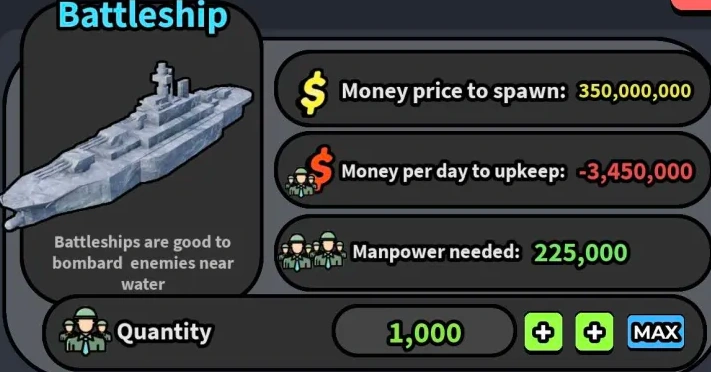
What makes it worth that: only planes, artillery and missiles can damage a battleship, and it can shell the coast — every tank and infantry stack bounces off it. The counter-play is not a bigger army but one of those three unit types.
The five units behind technology
Planes
Planes are expensive but stronger than artillery, with two documented jobs: they press down city defence — the blue bar on a fortified city — and they are one of the three things that can damage a battleship. They need an airport, and airports exist only in capitals. No cost figure is published.
Anti Aircraft and Missile Launchers
Anti Aircraft is research-gated with no published cost figures in the wiki tables. The Missile Launcher, by contrast, spawns for the same as tanks, and each missile costs 10,000,000 money plus 500 manpower to fire. Missiles bombard cities — the third counter to a battleship — and they can damage your own troops.
Artillery
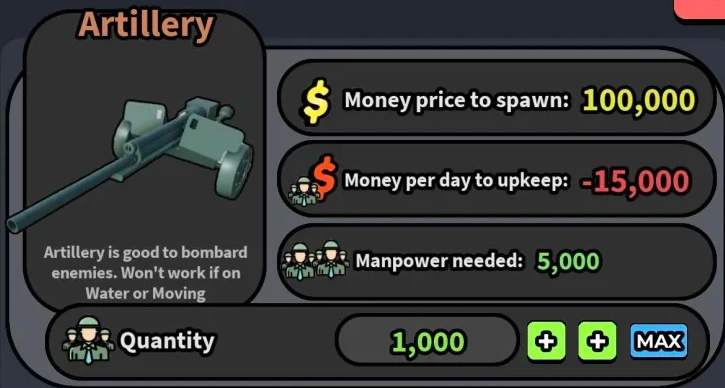
Artillery is the bargain of the roster: 100,000 per gun and 15,000 a day, with a ceiling of 50,000 guns per division.
The catch is positional: artillery is not suited to frontal combat. With a small infantry screen in front of it, a modest artillery force eats through a much larger army.
Aircraft Carriers
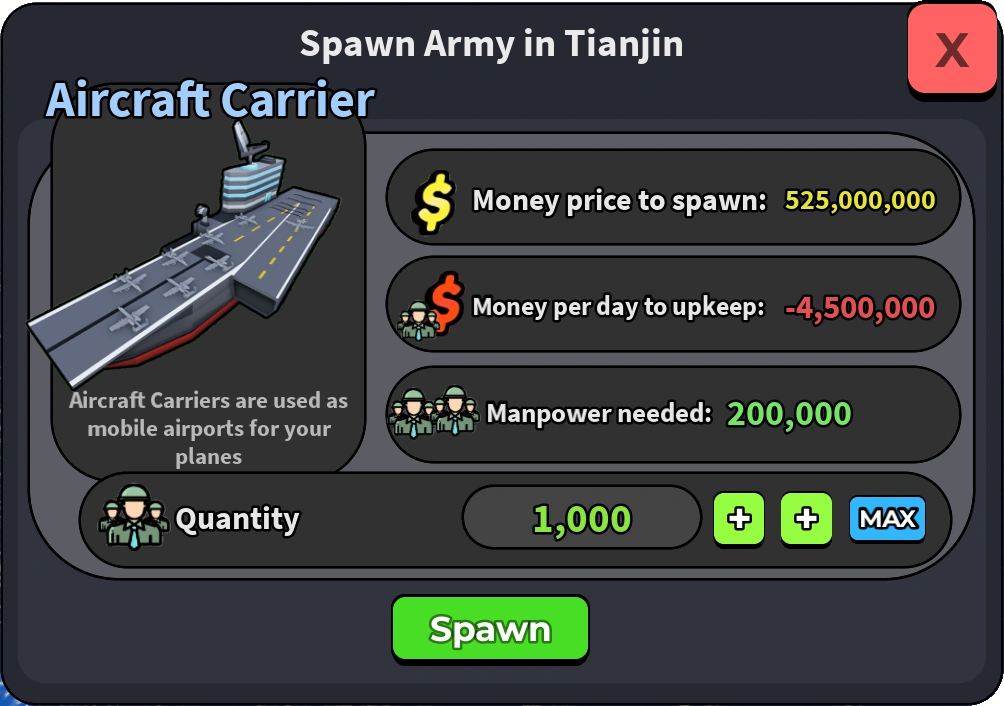
Carriers arrived on 2026-04-03 and sit at the end of the naval line: they require navy technology level 3. One division costs 525,000,000 money and takes 120 seconds to build — at 4,500,000 a day, the highest upkeep of any single unit here.
It buys the longest range in the game and a mobile airport, but a carrier is countered by battleships — so a carrier fleet still needs something else on screen.
Counter chart: what beats what
| Situation | What happens |
|---|---|
| Tanks run into infantry | Tanks win, at 20x the money, 6x the upkeep and 2x the manpower |
| Artillery meets infantry head-on | Artillery is out of its element |
| Artillery sits behind a small infantry screen | The screen holds while the artillery deletes a much larger force |
| Planes meet artillery | Planes cost more but are the stronger of the two |
| Anything without planes, artillery or missiles hits a battleship | Nothing happens — only those three units can damage it |
| Battleship meets aircraft carrier | The carrier is countered |
| Artillery under full city defence | Attacking forces under 1M get wiped out |
| Missiles fired into your own lines | Friendly fire; missiles can damage your own troops |
| Planes over a fortified city | City defence (the blue bar) gets pressed down |
Flanking, siege speed and army size
If two or more ground units attack the same enemy from different directions at the same time, that enemy takes severe damage — the flanking bonus, and the reason splitting a stack before an attack beats feeding it in piece by piece.
Siege speed follows the same logic: capture speed equals troop count plus technology plus multi-direction encirclement — surrounding from several sides is the multiplier most players leave on the table.
Army size is bounded by manpower rather than money: everyone starts with 60,000 manpower, the cap is 2% of your population and daily gain runs about +0.014% of population, so a large standing army is paid for one day at a time — a better argument against overbuilding than any cost table.
Related guides
- How to play — controls and army orders.
- Best countries — ports, capitals and income.
- Formables — the wars these units are for.
- Cities and economy — money and manpower.
- Alliances and war — political power costs and betrayal timing.
- Codes — no code box; claim the group boost instead.