
Cities, money and manpower
Every city you own pays tax and feeds manpower, so upgrading city tier is the strongest thing you can do early. City tier and city defence both cap at level 10, and occupied cities cannot spawn units.
Where income comes from
Money is the primary currency in Control Europe. It buys military units, upgrades cities and funds technology, and it arrives almost entirely as tax from the tiles you hold. There is no separate economy sim behind it: more cities means more tax, higher city tier means more tax per city, and technology multiplies what you already own.
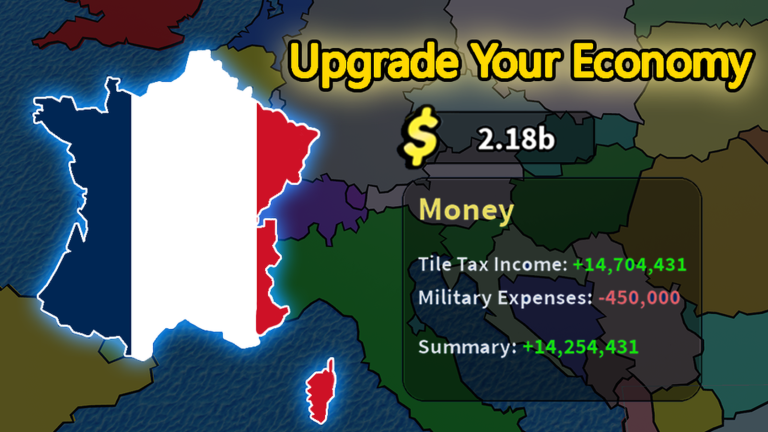
The money panel shows the same three lines every time, so you can read your economy without a guide:
| Line | What it means | What to do about it |
|---|---|---|
| Tile Tax Income | Green figure — total tax from every tile you control | Grow this by taking cities and raising city tier |
| Military Expenses | Red figure — daily upkeep of every unit you have | Cut it before it eats the surplus; upkeep is per-unit and constant |
| Summary | Net per day — green if positive, red if negative | If this is negative, your army is bigger than your empire |
A late-game screenshot of the panel shows the scale this reaches: +14,704,431 tile tax income against -450,000 military expenses, leaving +14,254,431 per day. That ratio — income roughly thirty times upkeep — is what a healthy empire looks like once city tiers are up.
Cities are the whole economy
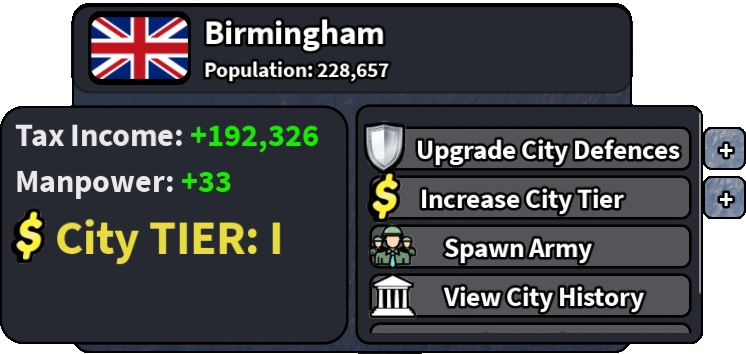
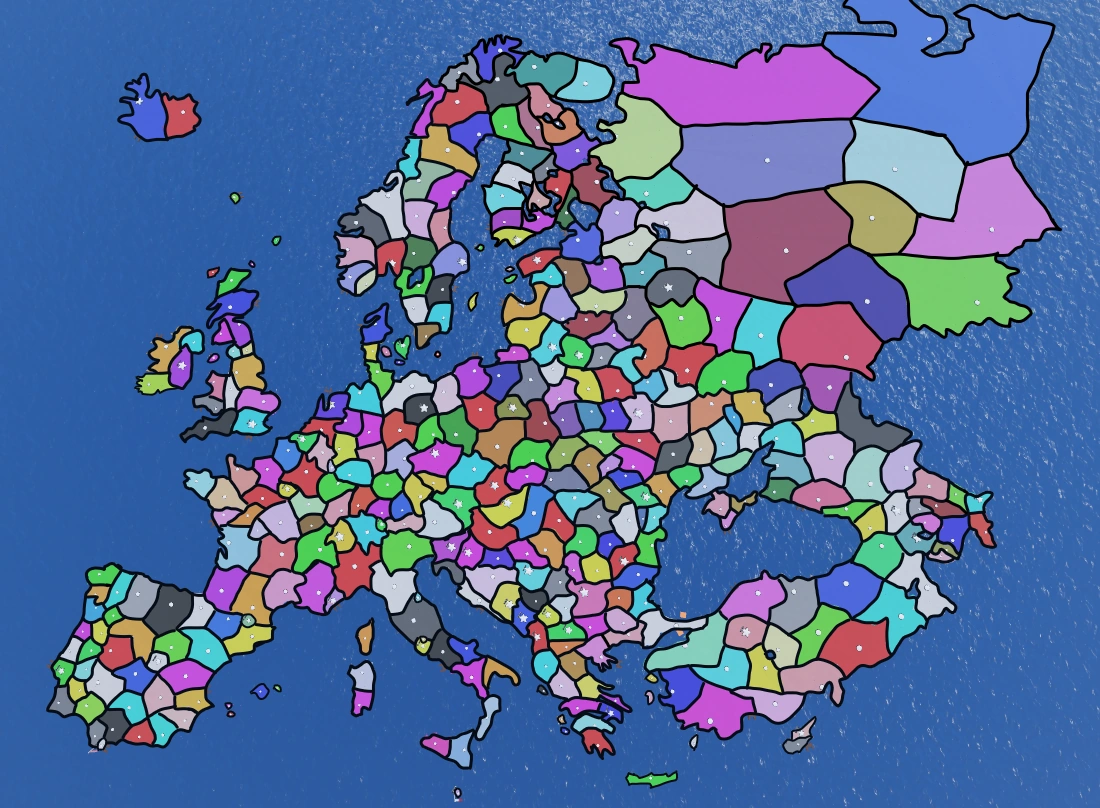
Cities — also called tiles — are the building block of a country. Each one provides money, manpower, and a place to spawn units. Every country starts with at least one city, and one of them is the capital.
Three numbers on a city matter:
- City tier levels from 1 to 10 (shown as X at the top). Every level raises both income and manpower production. Cities start at tier 1 and can never drop below it.
- City defence also caps at level 10. It makes the city harder for enemy units to take, and it costs manpower and money to raise.
- Population drives the manpower formula described below.
Upgrading city tier is the single strongest thing you can do in the early game, because it raises two of your three resources at once. The community wiki puts it bluntly: prioritize city upgrades to secure a large manpower reserve, whether you are a small nation or a large one.
Airports and ports are not cosmetic
Airports appear only on capital cities and are required to build planes. Ports — wooden docks leading into the ocean — are required to build battleships. If your capital falls and you have no other airport, you cannot replace planes at all, which is a real reason to defend the capital beyond the flag on it.
Planes strip city defence from the air
Putting planes over an enemy city drains its defence tier. A blue bar appears — similar to the yellow capture bar but blue — and falls until the city has no defence tier left. This is the counter to a max-level walled city when you do not have missiles to spare.
Occupied cities are not real cities
Taking a city in war does not give you a normal city. Occupied cities work differently, and the differences decide whether an occupation is worth holding:
- Tax income is slightly lower than it was under the original owner.
- You cannot deploy military units from an occupied city. This is the rule that catches people out — an occupied port or airport produces nothing for you.
- They still count toward your total controlled tiles, and they add a small amount to your manpower reserve.
- Occupied cities cannot be ceded to another country.
- They can only be annexed — made properly yours — when the occupied country is at peace with you.
So an occupation is a delay, not a conquest. Hold the territory, wait for peace, annex, and only then does the city start paying full tax and spawning units.
Manpower: the formula behind your army
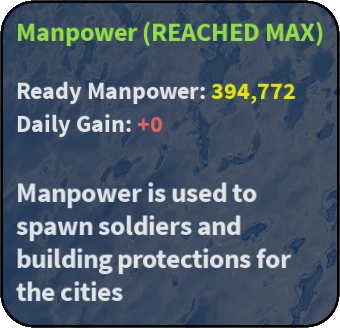
Manpower is the currency every unit consumes, and it is separate from money. Each country produces it daily up to a maximum, and both figures move with population.
| Rule | Value | Source note |
|---|---|---|
| Starting manpower | 60,000 for every country, regardless of its limit | Community wiki |
| Maximum | 2% of population; when population exceeds 2.5 million, the wiki records a further cap of 50,000 | Community wiki — read as documented, not as an official tooltip |
| Daily gain | Usually +0.014% of population | Community wiki |
| Raised by | Growing population, upgrading cities, improving technology | Community wiki |
Two practical consequences:
- A big population does not automatically mean a big army — the cap and the daily rate both scale off population, so a wide empire with underdeveloped cities underperforms a smaller one with tier-10 cities.
- Starting at 60,000 means every nation can field something on turn one. Spending it all on infantry in the first minute is the most common way to have nothing when a neighbour declares.
City defence upgrades cost manpower on top of money, scaled to the city's population and tier, so defence spending competes directly with unit production. Choose one: wall up, or field an army — doing both slowly loses to whoever picked one.
Technology scales with your size
Technology improves military strength and tax gains, but its cost depends on how big your country is. San Marino's technology costs far less than the United States's, which is why country size is a trade-off and not just a bonus: you are sacrificing immediate power for cheaper technology, or the reverse.
A major power has the income to out-spend everyone; a minor power can field proportionally better troops sooner. Neither is wrong — but the minor power has to use its technology advantage before the major power's income catches up.
Occupying versus building: what to do first
A working order for the first ten minutes:
- Check the money panel. If Summary is red, stop adding units until tax catches up.
- Upgrade cities, not army size. Tier raises income and manpower at the same time, and it compounds for the rest of the match.
- Build only what you can maintain. Upkeep is daily and unconditional; a large army with negative summary bleeds out slowly while a smaller one with positive summary grows.
- Keep a manpower reserve. City defence and reinforcements both draw from it, and it refills daily rather than instantly.
- Take cities for manpower too. Annexing territory raises manpower the same way upgrading does — conquest is a way to grow your army limit, not just your map.
Related guides
- How to play Control Europe — controls and your first game
- Best countries to start with — the size-versus-technology trade-off
- Formables and how to form them — what to conquer towards
- Military units and combat — what all that money buys
- Alliances and political power — the diplomacy costs
- Control Europe codes — why there are none, and the free boost instead