
Alliances and political power
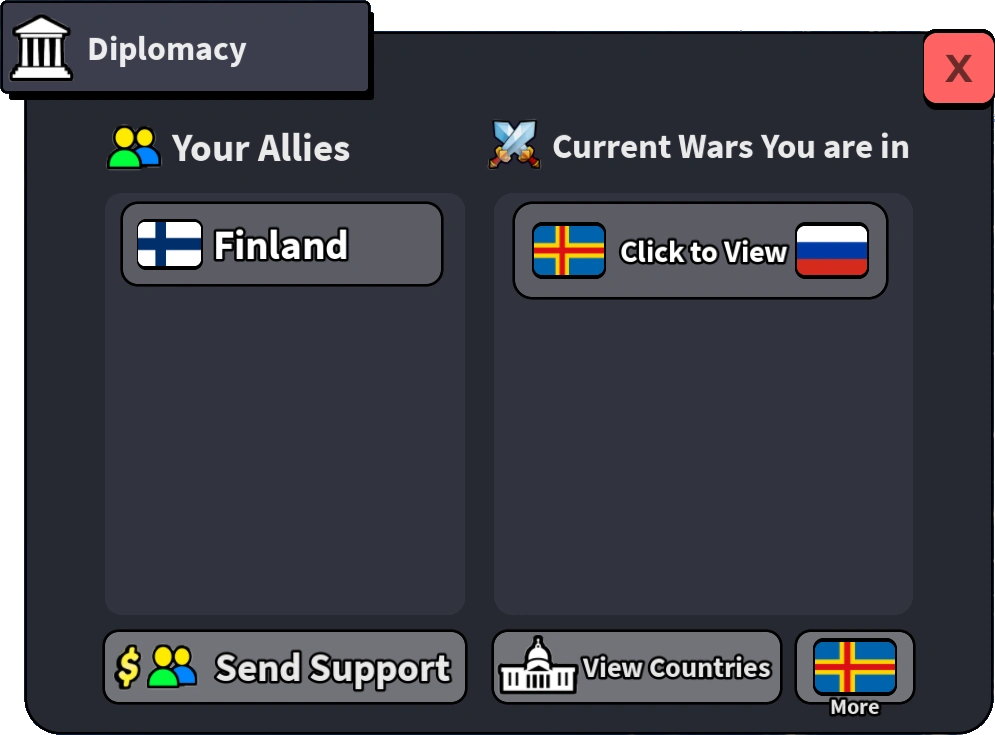
Creating an alliance costs 50 political power and joining or leaving costs 30; justifying a war costs 50 on the Europe map and declaring costs 10. Breaking an alliance gives the other side a four-month preparation window, so betray only when your army is already built.
Political power: the diplomacy currency
Political Power (PP) is what every diplomatic action in Control Europe is paid for with — justifying wars, declaring them, making alliances and leaving them. Every country produces it at +0.25 per day by default, technology can raise that, and production stops at a cap of 500. In private servers the cap can be set as high as 10,000.
At the default rate, one day of production buys you almost nothing. Two months of stockpiling buys a war. Everything below is why timing matters more than doctrine in this game.
| Action | Cost | Notes |
|---|---|---|
| Daily production | +0.25 | Default; raiseable through technology |
| Production cap | 500 | Nothing accumulates past this; 10,000 in private servers |
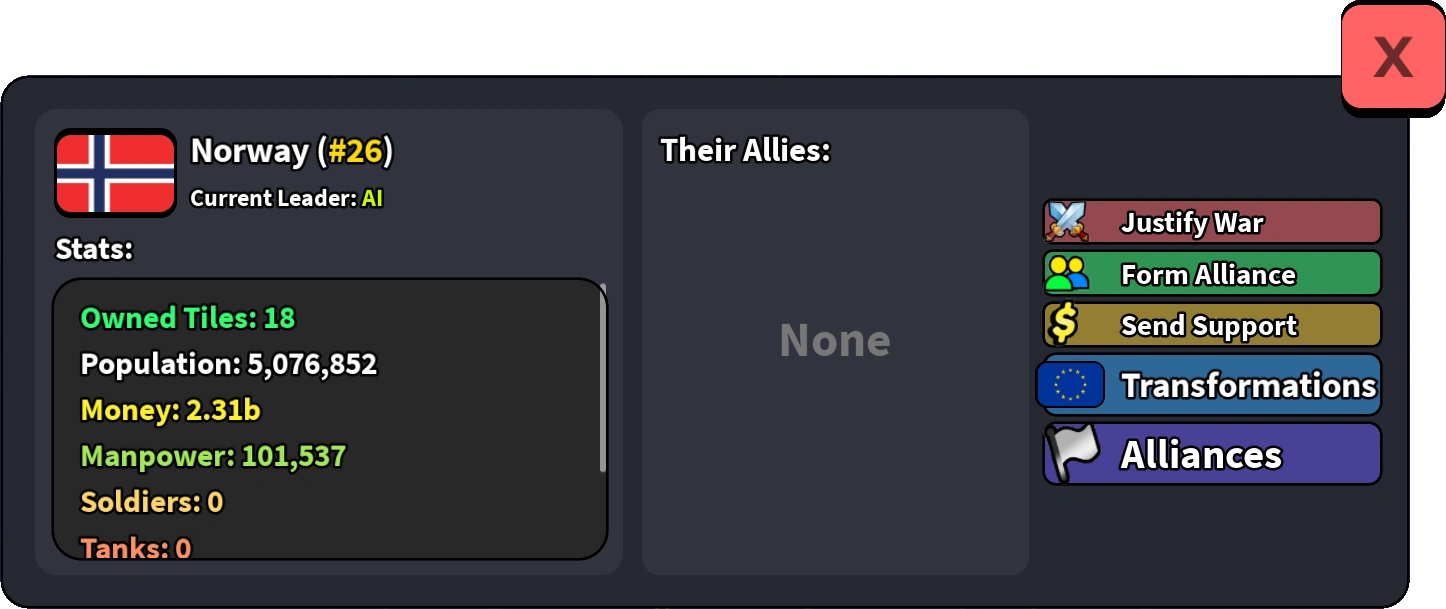
| Justify war (world map) | 17 | The claim-taking step before a war |
| Justify war (Europe map) | 50 | The Europe map charges three times as much |
| Declare war | 10 | Paid on top of the justification |
| Create an alliance | 50 | Plus a colour and a name that passes Roblox moderation |
| Join an alliance | 30 | Paid by the joining country |
| Leave an alliance | 30 | Same price as joining |
The Europe map's 50 PP justification is the number to remember, because that is the map most people play. It means roughly seven months of default production for a single claim — which is exactly what the 2x Political Power gamepass, at 400 Robux, is priced against.
What an alliance actually gives you
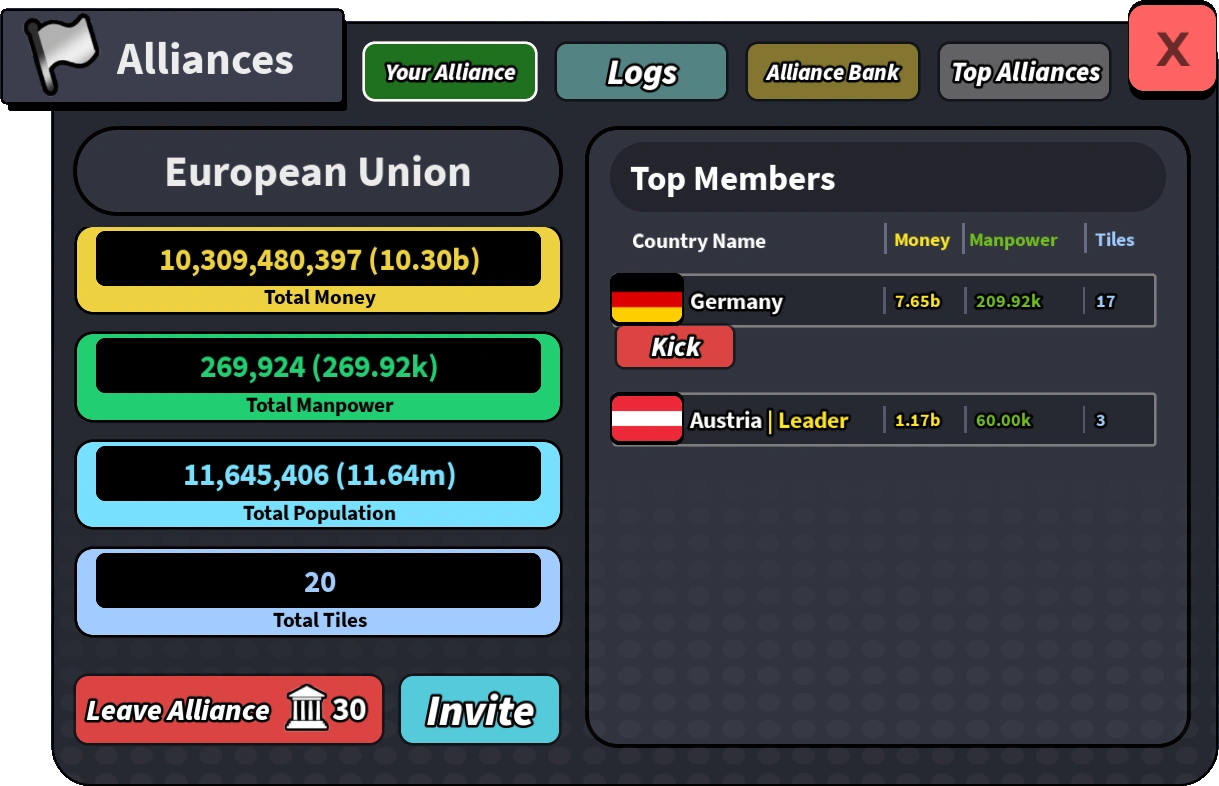
Alliances were added on 12 October 2025 and replaced the older one-to-one alliances. Creating one costs 50 PP; the leader picks the name and colour, and every country that applies has to be approved by all existing members. The leader can remove anyone at any time.
What members get:
- Free movement. Your units take no damage moving through allied territory.
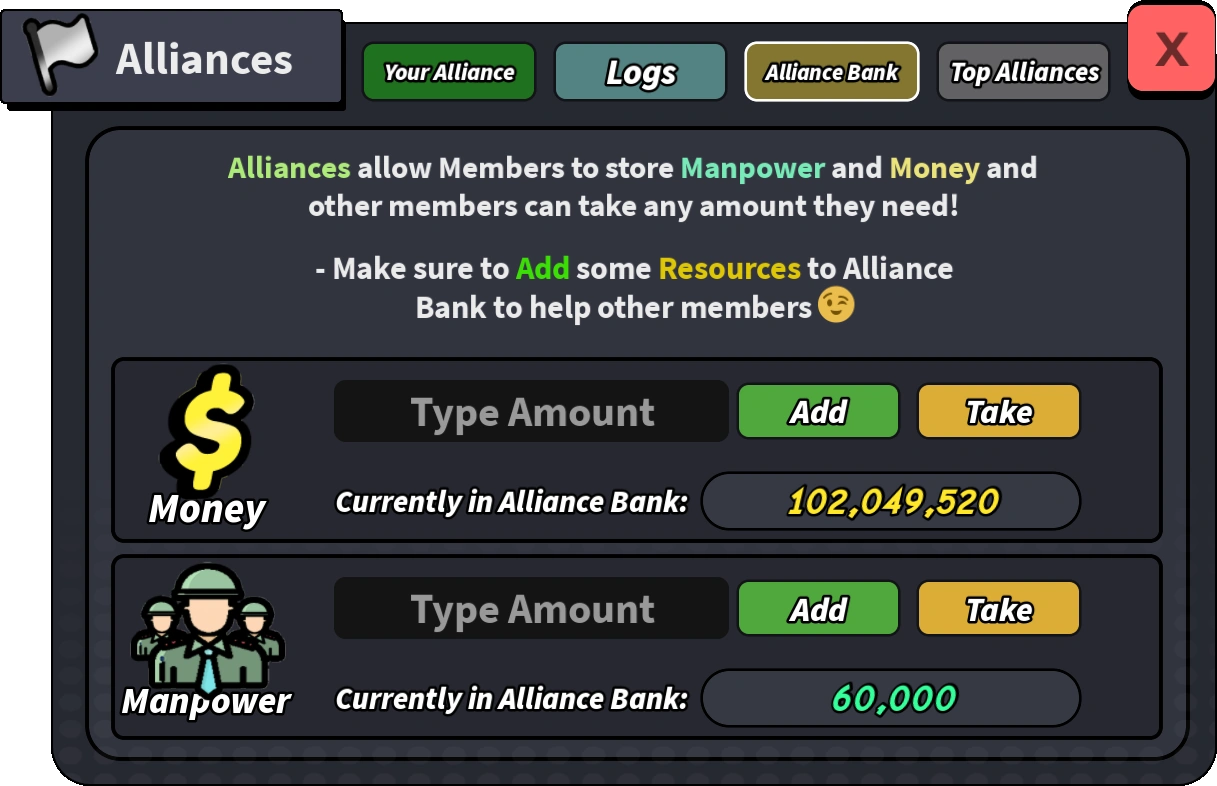
- A shared bank. All members can deposit or withdraw money and manpower with no limit — this is how a smaller member gets funded by a larger one.
- A shared intelligence view. The alliance UI shows total money, manpower, population and tiles, plus each member's individual contribution.
- A private chat channel.
- Trust. Allies are less likely to break ties casually, and members cannot simultaneously belong to another alliance — joining automatically severs previous ones.
You cannot see other alliances' statistics or who founded them, so intelligence on rival blocs has to come from what you can observe on the map.
The four-month window: how betrayal actually works
Breaking an alliance does not surprise anyone instantly. When a country leaves or breaks ties, the other side gets a four-month preparation period before the practical consequences land. The community wiki's reading of this: apart from being dragged into wars you did not want, there are few downsides to being in an alliance — the trust and the free movement outweigh the risk.
That framing decides how betrayal should be timed:
- Build the army first, then break ties. The four-month window is a head start on your side, not a delay you suffer — you already have the troops massed.
- Combine it with unit-type advantage. If you researched what your ally did not, the window barely matters: by the time they can respond, the fight is decided.
- Do not betray from weakness. A partner who sees your army growing inside the alliance sees it either way; the window only helps if what you built is bigger than what they can field.
- Watch for the reverse. An ally massing an unusual number of troops near your border is using the same playbook — the window works both ways.
War, without the wasted PP
Justification is the expensive part, so spend it deliberately:
- Justify on the Europe map at 50 PP, not the world map at 17, only when you mean it. The map you are playing sets the price; check which map you loaded into before committing months of production.
- Declaration itself is cheap (10 PP). The cost is in the claim, so multiple declarations under one justification strategy are far cheaper than re-justifying repeatedly.
- Peace is a mechanic, not a pause. Occupied cities can only be annexed when the occupied country is at peace with you — a long war keeps you collecting occupied cities that cannot spawn units or pay full tax.
- Allies can drag you in. The main listed downside of alliance membership is being pulled into wars you did not start; if you want to control every declaration, stay out of blocs and pay the 30 PP to leave.
What to spend PP on, in order
A workable priority list for a default-PP country:
- Justify on the neighbour you can actually take — 50 PP on Europe, once.
- Declare the moment the claim lands — 10 PP is cheap enough to never be the bottleneck.
- Annex at peace, not during the war — occupation gives you tiles and a little manpower but no units and reduced tax.
- Join an alliance (30 PP) only if it delivers something concrete: bank funding, safe movement, or a shared enemy. Otherwise the 30 PP is better spent leaving one.
- Create an alliance (50 PP) only once you have something to lead with — members approve each other, and an empty promise does not.
Related guides
- How to play Control Europe — controls and your first game
- Best countries to start with — picking a start that can afford PP
- Formables and how to form them — what conquest is building towards
- Military units and combat — the army that makes betrayal work
- Cities, money and manpower — the economy under all of this
- Control Europe codes — the free boost, and why there are no codes